The Physical Model
All integration algorithms are derived from Newton’s second law of motion. For a particle subjected to a force $F$:
$$ \begin{align} F = ma = m \frac{d^2x}{dt^2} \end{align} $$We usually split it into two first-order differential equation:
$$ \left\{ \begin{aligned} \frac{dx}{dt} & = v \\ \frac{dv}{dt} & = a = \frac{F_{net}}{m} \end{aligned} \right. $$Explicit Euler
This is the most intuitive solution, assume the step is $\Delta t$:
$$ x_{n+1} = x_{n} + v_{n} \Delta t \\ v_{n+1} = v_{n} + a_{n} \Delta t $$But it is extremely unreliable since it actually assumes that in a step, the velocity and the acceleration are constant.
Semi-Implicit Euler
This is what I used in my project and it has just a slightly change compare to Explicit Euler, it updates the velocity and uses the new velocity to update the position.
$$ v_{n+1} = v_{n} + a_{n} \Delta t \\ x_{n+1} = x_{n} + v_{n+1} \Delta t $$It is much more reliable than the Explicit Euler.
Note: Rk4 and Implicit Euler is not considered here since they much more complicated than the above two methods and in most cases, semi-implicit euler can do its job pretty well.
The Moment of Inertia Matrix
In 3D space, the “resistance to rotation” of an object is different for different axis. This cannot be expressed by a constant, but rather as a matrix of 3x3, which completely describes the distribution of mass in all directions. As long as the shape of the object does not collapse, this $I_{body}$ will not change.
For the world coordinate system, the “resistance to rotation” of the object is keep changing with its posture. Which means that, we must convert the $I_{body}$ to the $I_{world}$ all the time so that we can calculate the effect of the external forces on it correctly.
We know the Angular Momentum Theorem:
$$ L = I \omega $$It is true for both the world space and the local space:
$$ \begin{align} L_{local} &= I_{body} \omega_{local} \\ L_{world} &= I_{world} \omega_{world} \end{align} $$To convert a vector from the local space to the world space, multiply current rotation matrix $R$:
$$ \begin{align} L_{world} &= R L_{local} \\ \omega_{world} &= R \omega_{local} \\ \omega_{local} &= R^{-1} \omega_{world} \end{align} $$Note:$$ \left[ \begin{matrix} R_{11} & R_{12} & R_{13} \\ R_{21} & R_{22} & R_{23} \\ R_{31} & R_{32} & R_{33} \end{matrix} \right] \left[ \begin{matrix} x_{local} \\ y_{local} \\ z_{local} \end{matrix} \right] = \left[ \begin{matrix} x_{world} \\ y_{world} \\ z_{world} \end{matrix} \right] $$
Substitutes:
$$ \begin{align} L_{world} &= R (I_{body} \omega_{local}) \\ L_{world} &= R I_{body} R^{-1} \omega_{world} \end{align} $$So $I_{world}$ is equal to:
$$ I_{world} = R I_{body} R^{-1} $$And in the physics engine, we care about its inverse matrix because we need it to calculate the angular acceleration.
$$ \begin{align} I_{world}^{-1} &= (R I_{body} R^{-1})^{-1} \\ I_{world}^{-1} &= (R^{-1})^{-1} I_{body}^{-1} R^{-1} \\ R^{-1} &= R^T \\ I_{world}^{-1} &= R I_{body}^{-1} R^T \\ \end{align} $$Note: Replace the $R^{-1}$ by $R^T$ is because calculate $R^T$ is much faster than $R^{-1}$.
The Angular Acceleration
$$ \begin{align} \tau &= \frac{dL}{dt} \\ L &= I \omega \end{align} $$Assume $I$ stays constant in a short period of time:
$$ \tau = \frac{d(I\omega)}{dt} = I\frac{d\omega}{dt} \\ \tau = I \alpha $$In 3D space, $\tau$ and $\alpha$ are vectors with size 3x1. $I$ is a matrix of size 3x3.
$$ \left[ \begin{matrix} \tau_{x} \\ \tau_{y} \\ \tau_{z} \end{matrix} \right] = \left[ \begin{matrix} I_{xx} & I_{xy} & I_{xz} \\ I_{yx} & I_{yy} & I_{yz} \\ I_{zx} & I_{zy} & I_{zz} \\ \end{matrix} \right] \left[ \begin{matrix} \alpha_{x} \\ \alpha_{y} \\ \alpha_{z} \end{matrix} \right] \\ \begin{align} I^{-1} \tau &= (I^{-1}I)\alpha \\ I^{-1} \tau &= \alpha \\ \alpha &= I_{world}^{-1} \tau \\ \omega_{n+1} &= \omega_{n} + \alpha \Delta t \end{align} $$Summary
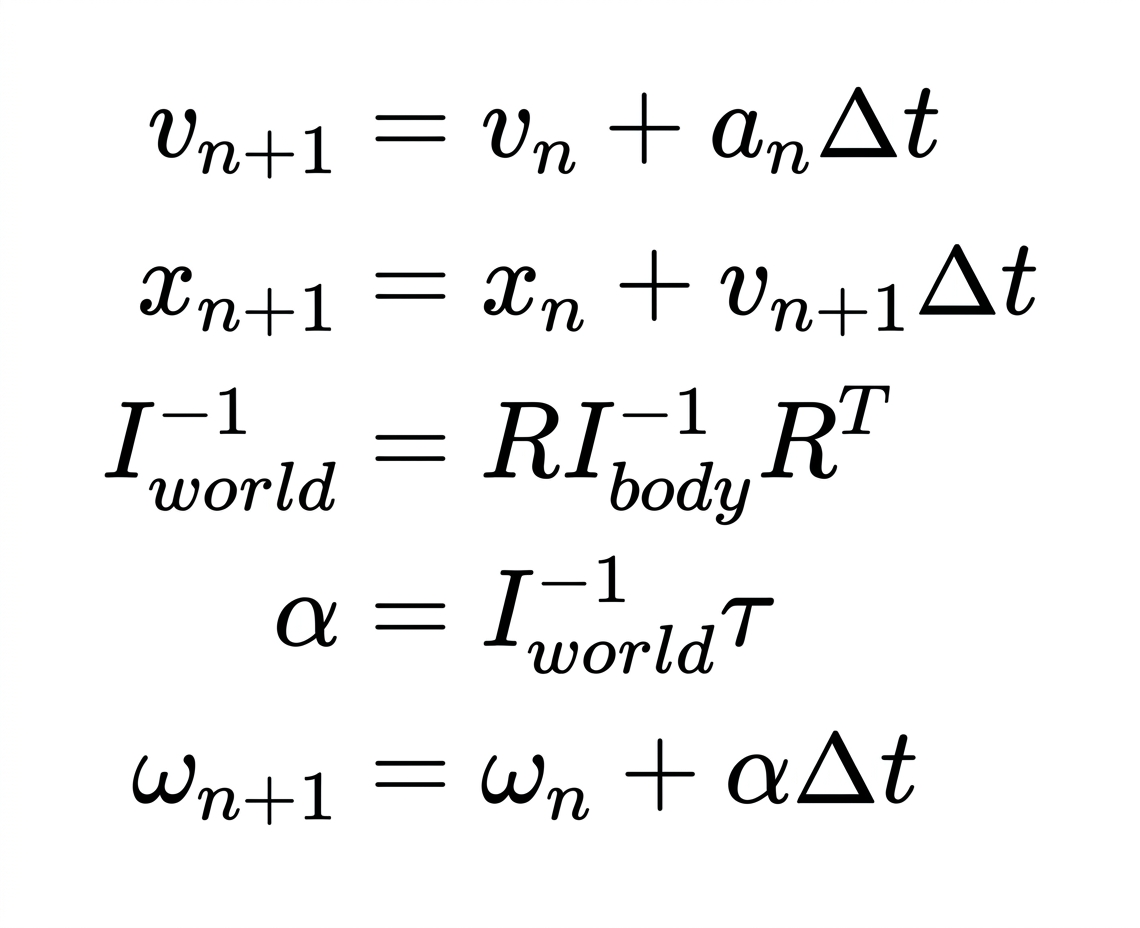
So, for each object in every time step, these should be updated by the integrator:
$$ \begin{align} v_{n+1} &= v_{n} + a_{n} \Delta t \\ x_{n+1} &= x_{n} + v_{n+1} \Delta t \\ I_{world}^{-1} &= R I_{body}^{-1} R^T \\ \alpha &= I_{world}^{-1} \tau \\ \omega_{n+1} &= \omega_{n} + \alpha \Delta t \end{align} $$