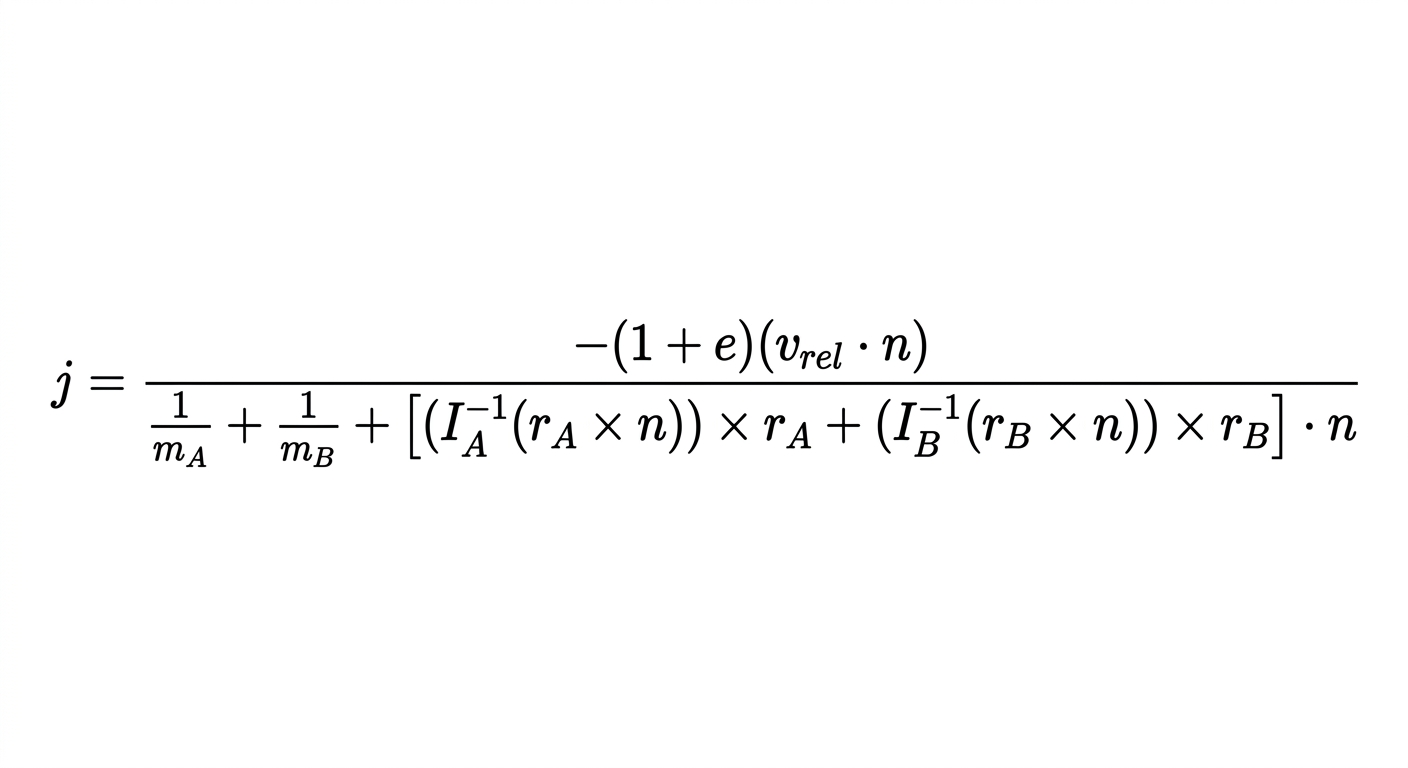
Problem:
For a rigid body A with mass $m_{A}$ and another rigid body B with mass $m_{B}$ collide with linear velocity $v_{A},v_{B}$ respectively, solve for the scalar impulse $j$ of the two object. Friction is negligible.
Variables:
| Symbol | Definition |
|---|---|
| $m_{A},m_{B}$ | Mass of object A and B |
| $I_{A},I_{B}$ | Moment of inertia tensor of object A and B |
| $x_{A},x_{B}$ | Center of Mass |
| $P$ | Contact point |
| $r_{A},r_{B}$ | $P-x$ |
| $v_{A},v_{B}$ | linear velocity before impact |
| $\omega_{A},\omega_{B}$ | Angular velocity before impact |
| $v_{PA},v_{PB}$ | Absolute linear velocity of the contact point |
| $v_{rel}$ | relative velocity of contact point |
| $n$ | Contact normal (unit vector) |
| $e$ | coefficient of restitution |
| $J$ | impulse vector |
| $j$ | impulse scalar |
Derivation:
The velocity of any point on a rigid body is the sum of its linear velocity and its tangential velocity due to rotation. From the definition:
$$ \begin{align} r_{A} = P - x_{A}, r_{B} = P - x_{B} \begin{aligned} v_{PA} &=v_{A}+\omega_{A} \times r_{A} \\ v_{PB} &= v_{B}+\omega_{B} \times r_{B} \\ \end{aligned} \end{align} $$The relative velocity of body B with respect to body A at the contact point:
$$ v_{rel} = v_{PB} - v_{PA} $$The impulse $J$ acts along the contact normal $n$:
$$ J = jn $$According to Impulse-Momentum Theorem ($\Delta v=\frac{J}{m}$):
$$ \begin{align} v_{A}'=v_{A}-\frac{j}{m_{A}}n \\ v_{B}'=v_{B}+\frac{j}{m_{B}}n \end{align} $$The impulse also applies a torque which changes the angular velocities ($\Delta \omega = I^{-1}(r \times J)$):
$$ \begin{align} \omega_{A}'=\omega_{A} - I^{-1}_{A}(r_{A}\times jn) \\ \omega_{B}'=\omega_{B} + I^{-1}_{B}(r_{B}\times jn) \end{align} $$Then the velocity of the contact point immediately after the impact can be expressed as:
$$ \begin{align} v_{PA}'=v_{A}'+\omega_{A}'\times r_{A} \\ \\ v_{PB}'=v_{B}'+\omega_{B}'\times r_{B} \end{align} $$Substitute the equations into this expression:
$$ \begin{align} v_{PA}' &= (v_{A}-\frac{j}{m_{A}}n)+(\omega_{A} - I^{-1}_{A}(r_{A}\times jn)) \times r_{A} \\ v_{PB}' &= (v_{B}+\frac{j}{m_{B}}n) + (\omega_{B} + I^{-1}_{B}(r_{B}\times jn)) \times r_{B} \end{align} $$Factor out the $j$ and simplify:
$$ \begin{align} v_{PA}' &= v_{PA} - j[\frac{n}{m_{A}} + (I^{-1}_{A}(r_{A}\times n)) \times r_{A}] \\ v_{PB}' &= v_{PB} + j[\frac{n}{m_{B}} + (I^{-1}_{B}(r_{B}\times n)) \times r_{B}] \end{align} $$The new relative velocity:
$$ \begin{align} v_{rel}'=v_{PB}'-v_{PA}'&= ((v_{B}+\frac{j}{m_{B}}n) + (\omega_{B} + I^{-1}_{B}(r_{B}\times jn)) \times r_{B}) - (v_{PA} - j[\frac{n}{m_{A}} + (I^{-1}_{A}(r_{A}\times n)) \times r_{A}]) \\ v_{rel}'&=v_{rel}+j(\frac{n}{m_{A}} + (I^{-1}_{A}(r_{A}\times n)) \times r_{A} + \frac{n}{m_{B}} + (I^{-1}_{B}(r_{B}\times n)) \times r_{B}) \end{align} $$According to Newton’s law of Restitution, the ratio of the relative speed of separation and the relative speed of approach when two objects collide equals to the coefficient of restitution.
$$ v_{rel}' \cdot n = -e (v_{rel} \cdot n), e \in [0, 1] $$Substitute $v_{rel}’$ and simplify the equation:
$$ \begin{align} \left[ v_{rel}+j\left( \frac{n}{m_{A}} + (I^{-1}_{A}(r_{A}\times n)) \times r_{A} + \frac{n}{m_{B}} + (I^{-1}_{B}(r_{B}\times n)) \times r_{B} \right) \right] \cdot n &= -e (v_{rel} \cdot n) \\ j\left( \frac{n}{m_{A}} + (I^{-1}_{A}(r_{A}\times n)) \times r_{A} + \frac{n}{m_{B}} + (I^{-1}_{B}(r_{B}\times n)) \times r_{B} \right) \cdot n &= -(1+e)(v_{rel} \cdot n) \\ j = \frac{-(1+e)(v_{rel} \cdot n)}{\left( \frac{n}{m_{A}} + (I^{-1}_{A}(r_{A}\times n)) \times r_{A} + \frac{n}{m_{B}} + (I^{-1}_{B}(r_{B}\times n)) \times r_{B} \right) \cdot n } \\ j = \frac{-(1+e)(v_{rel} \cdot n)}{ \frac{1}{m_{A}} + \frac{1}{m_{B}} + \left[(I^{-1}_{A}(r_{A}\times n)) \times r_{A} + (I^{-1}_{B}(r_{B}\times n)) \times r_{B} \right] \cdot n } \end{align} $$